Showing posts with label Look. Show all posts

March 2, 2024

Chasing Berenice Abbott's Light in Boston's South End


Planting inspirational seeds in advance of my students taking images on the topic of “Cities”, l showed them photographs of New York City, including “New York Stock Exchange, New York”, 1933, by Berenice Abbott.

Stepping Out - Or Was It In?
Today, l chased her light, taking pictures in Boston’s South End. These images are interspersed with photographs l shot in 1977, at age 18, living in the same South End, studying the city and its people.

Alley Tree
Back then I shot with a Nikomat, developed and printed the work myself, and then glued the images into a photo journal.

Contrails Can Suppress Daylight
Today, I used an iPhone from my pocket and posted here and on Instagram.

Shadowy Alley
It is so fun to still be exploring the world, chasing light and shadow, regardless of the capture device and method of presentation.

Echoes of Japan
They say the best way to learn is to teach.

Sunny Day
So glad that planting city seed images for my students reawakened an exploratory mindset for me.

Professor John Nordell teaches courses in the Arts, Media, and Design Program at American International College in Springfield, Mass. He blogs about the creative process at CreateLookEnjoy.com. Instagram: create.look.enjoy

July 3, 2022

Plein Air: Watercolor Painting on the Water using Ocean Water

I recently passed my "sail check" so that I can rent sailboats from the Duxbury Bay Maritime School in Duxbury, Mass.  On this day, I brought my watercolor paint set and sketchbook.

Along the edge of the marsh, a tern splashed into the water, flying away with a fish.  Meanwhile, I splashed my brush into the ocean for water to paint with.

As I tacked back and forth working with the wind, I alternated between painting with my left and right hands.

The sights, the sounds, the sensations, the creating and the sailing all brought me into the precious now.


 Need I explain how much I love summer?

John Nordell teaches courses in the Visual and Digital Arts Program that he created at American International College in Springfield, Mass. He blogs about the creative process at CreateLookEnjoy.com  Instagram: @john.nordell

October 17, 2020

Taking Action, Clicking the Shutter, Making Things Happen

For many years working as a photojournalist, photo editors would call with a specific subject for me to photograph.

Professorial activities take most of my working energy these days.  On the rare occasion when I head out with my camera, sans editorial mandate, subject matter can initially be elusive.

Driving among farms near the Connecticut river in Massachusetts, the light streaming through corn leaves beckoned me from my car.

Photosynthetic Tendrils


Moving beyond photojournalism's straight shooting, these days I often create in-camera multiple exposures. Prowling around the corn field's edge, I layered images of found grass, clouds, trees and sky:

Seed Sky River


Nearby a freshly mown hayfield:

Not an Aerial
A farm photo essay without a red barn would be incomplete: 

Motif #12


Looking down from a bridge towards a river :

Leaves Over Untroubled Water

It all starts just by taking action, clicking the shutter the first time, making things happen.

John Nordell teaches courses in the Visual and Digital Arts Program at American International College in Springfield, Mass. He blogs about the creative process at CreateLookEnjoy.com  Instagram: @john.nordell


October 23, 2019

Crossing Paths Enriches Our Lives and New Technology Can Inspire Using Old Technology in a New Way


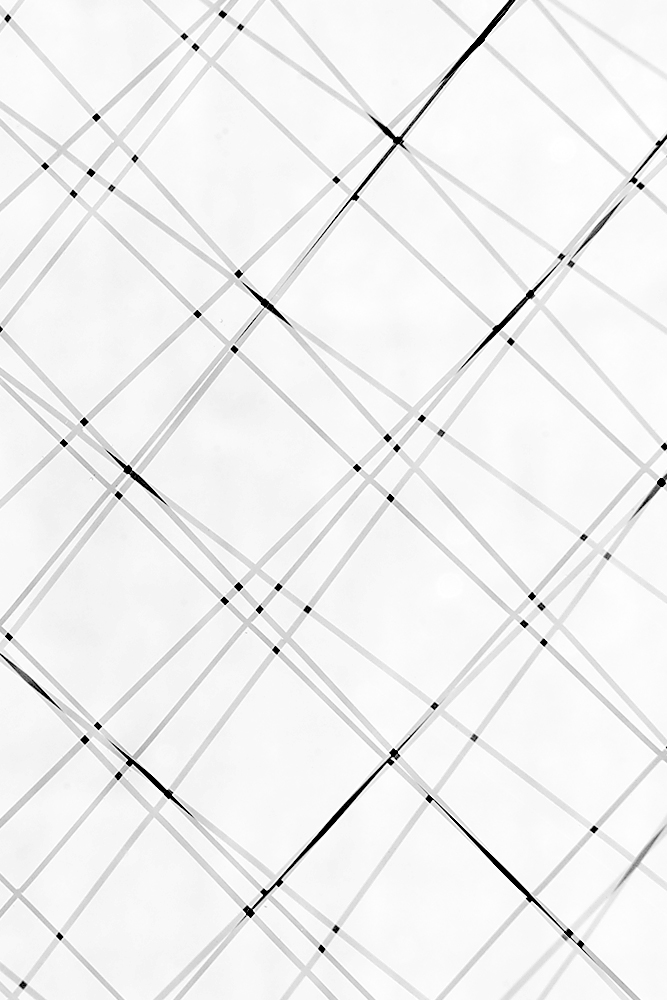
So excited that my one of my in-camera digital multiple exposures was chosen for F-Stop Magazine's Abstraction Issue. My image, Intersecting Lives and Lines, captures manifold views of a glass fire door at MASS MoCA.

Intersecting Lives and Lines
I see the gray lines as the journeys of individual humans. When our paths cross, our life experiences become deeper and richer.

Discovering that my Nikon DSLR allowed me to create in-camera multiple exposures like this sent me on a digitally enabled journey into abstraction.

In my prior days working as a photojournalist in the film era, I did everything I could to avoid double or multiple exposures.  In the past few years, I have begun shooting film again.

Empire State Building
This image I shot with a plastic Holga 120mm film camera. I was passing the Empire State Building in a cab and shot out the window, rotating the angle of my camera between each of four exposures on a single frame of film.

There are a few day left to bid on a print of this image, which I donated to raise money for the In-Sight Photography Project, a non-profit in Brattleboro, VT, that offers photography classes for all youth, regardless of their ability to pay.

I love the way a new technology inspired me to go in a new direction, which then led me to use an old technology in a new way.

Professor John Nordell teaches courses in the Visual and Digital Arts Program at American International College in Springfield, Mass. He blogs about the creative process at CreateLookEnjoy.com  Instagram: @john.nordell


March 19, 2013

Learning by Drawing: Portraying Reality with Abstract Paintings and Black and White Photographs


I am a huge fan of using sketchbooks to learn about art.

Figure 1 - Before
I sent some postcards of one of my Reality-Based Abstractions.  The Cubist painters inspired these in-camera multiple exposures.  I stuck one of the postcards in my sketchbook. 

Figure 2 - After
Inspired by woven mats I saw in the Oceanic collection at the Peabody Museum at Harvard, I cut another postcard into strips and interlaced them.

Guidelines
About a month later, I absorbed the Picasso Black and White exhibition at the Guggenheim.  Using pen and pencil to draw this painting allowed me to really look and linger.  I noticed the artist's initial drawn outlines that delineated the areas that he later filled in with tones.

Form
Using just pencil to create planes and values, I labored to recreate "Figure".  Notes jotted in my sketchbook:  "Ironic, that at points, I felt I was not recreating a Picasso perfectly.  A Picasso!  An abstraction!  Of all things."

Balance
After relaxing by leaning into and laughing at my fears, I drew this imagined ball rolling on a tightrope. 

Fruits of Labor
At the end of the afternoon, nearly dizzy from art overload, I drew this profile.  Looking closely at the Picassos taught me to look closely at reality.

Classwork

I relayed some of these observations a few weeks later as I taught a Zentangle® drawing class.  In most cases, with Zentangle, we draw with black pens on white paper, adding shading with regular pencils.  In this class, we reversed the formula.

The discussion of black and white led one student to recall the futility of looking at art history books during the era when such books were printed solely in black and white.  Another described how they felt that black and white photographs portrayed the reality of a situation better than color photographs.

Time Marches On
Interesting, this idea that black and white photographs are more true to reality than color ones.   I believe that portraying a single subject from multiple perspectives simultaneously (like the Cubist painters) can depict reality more clearly than a "normal" painting.  What do you think?

November 4, 2010

Oh, What a Beautiful Mornin' - Progressive Abstraction


Look | Sensory Inspiration

When photographic legend Jay Maisel speaks where I teach, he refers to the "terror" of seeing something wonderful, but missing the shot.

Centerline
When I drove over the ridge yesterday morning and saw this sky, my adrenaline began pumping as I raced through the town of Turners Falls to get to my "spot" along the Connecticut River. A cigarette-smoking, cell phone-yakking, crossing-the-street-without-looking teenager slowed my progress.

Music For My Eyes

Park. Open trunk. Retrieve camera. Check ISO. Check white balance. Assess exposure. Take a shot. Check histogram. Climb down riverbank to water's edge.

Like Butter
The files came out of my camera looking like this.

Tech Tips: Nikon D700, Nikkor 24-70 mm, ISO 200.  My shutter speeds progressively slowed, from 1/60 to 1/13 to 1/2, and with Music for My Eyes and Like Butter I moved my camera progressively faster during the exposures. ©2010 John Nordell

September 24, 2010

Is Photographing Art, Art?


Look | Sensory Inspiration

Three plus decades ago my high school photo class friends and I studied many photographers. However, the work of Tommy Alcorn (a young American photographer whose life was cut short by an accident at age 17) inspired and captivated us.  The black and white images were lyrical and seemed to probe the meaning of life.  Plus, he was a teen like us.

How old the tree?
When I took this image of a Civil War monument last winter in Deerfield, Mass., it reminded me that Mr. Alcorn had photographed statues in France and Italy.  The monument, erected in 1867 and constructed of brown freestone, is topped by a Union soldier who at some point lost his rifle.  Generations before Alcorn, French photographer Eugene Atget often chose such static subject matter. 

Bacchante and Infant Faun (1890)
I took this image of a Frederick MacMonnies bronze sculpture about a week later at The Clark art institute in Williamstown, Mass.  I used an old roll (circa 1997) of ISO 1600 film and only recently dropped it off for developing.


Atget, Alcorn and Me
When I saw the prints I pulled out my Atget and Alcorn books, both out of print, with varying degrees of page yellowing indicating relative and absolute age.

Deep connection I feel here, to my past, to the past.  

Tech Tips: Ansco Pix Panorama camera, no settings to set, 1600 ISO Fuji Neopan film processed and scanned at CTC/Vermont Color labs via Forbes Photo and Frame in Greenfield, Mass.

September 10, 2010

Lessons of a 3 Week Internet Fast


Look | Sensory Inspiration

Throughout the ages individuals have fasted from food as a spiritual practice of purifying body and mind.

Julia Cameron in her 1992 book, The Artist's Way (A Spiritual Path to Higher Creativity), suggests a week of reading deprivation to "jump start" your creative process.

Well, aside from one day when I was teaching, I spent the last 3 weeks of August offline.  I loved it.  I read more books.  I wrote postcards.  I used the dictionary and phone book. Stress about number of hits, likes, tweets, etc. evaporated.  I only took vacation photos.  All in all, a welcome break from my normal routine.  I did not want to go back online.

 Townhouse Neighborhood
As my internet fast neared conclusion,  I became concerned about what I would photograph once I got back into the swing of things.  The world around me seemed bland.  I was not living up to this statement from my About page: "The ultimate satisfaction from a lifetime of creating art and finding inspiration is the awareness that everything around me is art and has inherent value."

I was not seeing art everywhere.  WHAT AM I GOING TO PHOTOGRAPH? I dreamed one night that I was camera-less in a chaotic city, thinking to myself:  "I need my camera to make sense of this place."

Last Saturday in Brattleboro, Vermont I dropped off a print of Townhouse Neighborhood as a donation to the Insight Photography Project's annual print auction fundraiser.  Afterword, I wandered into the Brattleboro Museum and Art Center.  Photographs!  Sculpture!  Video!  Installations!  Constructions!

I left the museum, my creative well of inspiration filled, seeing photographs everywhere.  I returned the next morning with a camera:

Retaining Wall Art
Self-Portrait at the Museum Door

Ode to Kertesz
Chain Link Fence
This process of shifting from feeling creatively empty to visually full, from seeing my world as uninteresting to delighting in life, is the essence of Create Look Enjoy.

And, after a rough transition, I am back online, with a more relaxed perspective.


Tech Tips: Nikon D700,  ISO range 100-400.  Townhouse Neighborhood and Ode to Kertesz are in-camera multiple exposures.  With Chain Link Fence I shot at f22 at a 1/10 of a second while moving my camera.  © 2010 John Nordell

August 4, 2010

Times Square Through an Archeologist's Lens


Look | Sensory Inspiration

At function for a mutual friend I reconnected with Christopher Ratte, a high school classmate.  The archeologist and I exited the Harvard Club on 44rd street in Midtown Manhattan and were struck by the light.

Looking West No.2


Chatting and strolling, we headed uptown through Times Square.

Bright Lights

Later in the evening, I returned to photograph the tourist epicenter.

Red, Orange and Yellow


Thanks to Mark Rothko for his work with painting scale and color theory.  Between advertisements, I caught a blip of "blank" screen.

Top Down Living
Thanks to the sausage griller for smoke to shoot through.

Hailing a cab at 42nd Street and Broadway on a midsummer's night is a labor worthy of Hercules.

Taxi!


The woman's expression of grim determination broke briefly as she rebuffed a humorous come-on from a pedicab driver.

Times Square for me was about light, people watching, and wondering (a la singer Peggy Lee) "is that all there is?"

Classical Study
The following day, I saw Christopher Ratte again and asked him about viewing Times Square through an archeologist's lens.  His reply went something like this:

I noticed the grid of streets, the parks, the relationship with rivers.  The circulation system.  The grid in New York was based on maximizing the profits for real estate developers on the sales of lots.  The grids in ancient Greece were based on everyone getting the same sized lot. (Updated 8/4/10)

Two days later, he left to lead an expedition in Georgia (country).

Tech Tips: Nikon D700, 24-70mm, ISO range 500-2500.  Bright Lights is an in-camera multiple exposure.  ©2010 John Nordell

July 16, 2010

I Found the Process of Entering this Juried Art Competition Delightfully Rewarding


Look | Sensory Inspiration

(I am mailing today my submission for the Franklin County Biennial inaugural juried fine art exhibition.  The theme is Confluence.  Click images to enlarge.

My friend and teaching colleague Peter Chilton designed the Biennial's website and logo.  Take a look.  His keen and creative input has greatly influenced the design of this site.  Thank you Pete!)

I moved to Franklin County 4 years ago and was immediately taken with the land:  abundant rivers, sublime cornfields and trail-laced ridges.  I feel expansiveness, openness, greater than in Boston or the city's suburbs where I had previously made homes.

I came to teach photography after two decades of work, primarily as a photojournalist.  Freed from the dictates of assignment editors, I found myself experimenting with techniques.

My experiments refined into a series of Reality-Based Abstractions, which are digital multiple exposures.  As the image combining occurs in-camera, the raw files that emerge are flat and gray looking.  I use a computer darkroom to reveal rich detail, texture and color.

Railroad Bridge
Railroad Bridge is one of these abstractions.  Bicycles whir along where trains serving the mills used to rumble.  What's next for this transportation corridor?

Confluences
This bike path bridge is at left in Confluences.  Beyond the beauty of the literal confluence of the Connecticut and Deerfield rivers, the work addresses evolving image-making technology.  The top image was taken with a digital camera.  Digital grants the freedom to explore without concern for processing costs.  I shot the bottom image with a plastic, no-settings film camera.  I use it mindfully, not clicking the shutter unless the scene is just right.  I delight in the decidedly un-digital grain and blemishes.

Natural Roots
The South River flows through horse powered Natural Roots farm in Conway before later joining the Deerfield River.  Farmer David Fisher drives a team of four workhorses, pulling a harrow.  The spinning discs neutralize weeds by turning them into the soil.

Horse manure fertilizes the fields.  Hay and vegetables grow.  Hay fuels the horses.  The beautiful cycle of traditional, non-fossil fuel farming. 

Currents of the past and future gleaned from living life along Franklin County rivers swirl through my soul and fuel my artistic vision.

(P.S. Thank you Langston Hughes for your poem: 
The Negro Speaks of Rivers.)

June 24, 2010

Life's a Beach - And a Bitch


Look | Sensory Inspiration

If I am at the beach I am in the water.  Even if the temperature is, well, overly refreshing.

Beach Fences
The cold water shock followed by hot sun warming set my vision alive.

The View From Here
What's right with this picture?  I am at the beach... working!  Nothing like shooting first person stock photography. The image title comes from the name of my photo-consultant friend Selina Maitreya's audio business guide for photographers.

Chillin
Lifeguards Kevin Aufiero and Brendan Adams survey Duxbury (Mass.) Beach.  As I endeavored to fill my frame with storytelling details, I thought of two photographer friends, both facing the death of family members.  As I strained to compose so that Mr. Aufiero's nose crested the horizon line, salty tears rolled down my salty cheeks.  And as I shot a burst of frames to catch sunbathers walking up the ramp, I dedicated this image to my grieving photo buddies.

Tech Tips: Nikon D700, 24-70mm, ISO 200. Beach Fences is an in-camera multiple exposure treated with Topaz Adjust, a plug-in for Photoshop CS4.  ©2010 John Nordell

June 10, 2010

A Visit with Zen Master Thich Nhat Hanh plus Mistakes are Gifts


Look | Sensory Inspiration

Seated on my left,  Zen master Thich Nhat Hanh is doing calligraphy.  To my right, a Buddhist nun is pointing out the window and saying: "Look deeply at that blue sky.  Have you ever really looked at a blue sky?"  I follow her instructions.  Man, the sky looks blue!  Talk about present moment awareness.

Green Chakra

I encountered the meditation master and his followers 8 years ago on assignment at a monastery in Woodstock, Vt.  Photographing this week, the experience still resonated deeply as I stood on a bridge spanning the Connecticut River, surrounded by blue sky, blue water, green trees and green bridge superstructure.  New Hampshire on one side.  Vermont on the other.

I suggest taking several deep breaths and looking at the blue sky.

Spanning and Connecting


While digitally processing this multiple exposure of the bridge and Brattleboro's brick buildings and spires, I simplified the image elements.  The trees and their river reflections thrilled me as I felt they echoed the serenity that emanates from the paintings of my friend Julia Purinton.

Feeling fully alive and fully in the moment - two key ingredients for creative exploration - I decided that instead of layering multiples exposures on top of each other, I would layer three exposures, but selectively block portions of each frame with my fingers.

I Am Sun


In my excitement, I forgot to set my camera to layer the shots, so I ended up with three distinct images, rather than one comprised of three overlapping planes.  I assembled the result in this triptych. See it larger.

This error opened a new way seeing for me.  I explored it.

Breakthrough

I treasure the encounters photography has brought into my life.  I stay connected to Thich Nhat Hanh's calming influence with one of his books:  Peace is Every Step: The Path of Mindfulness in Every Day Life.

TechTalk: Nikon D700, 24-70mm, ISO 200. Spanning and Connecting is an in-camera multiple exposure treated with Topaz Adjust, a plug-in for Photoshop CS4. The assembled images were shot at 1/25 sec and f22 while I shook the camera. ©2010 John Nordell