Showing posts with label Z6. Show all posts

June 28, 2024

Toads, Arks and Rocks

It's hot and humid. I'm hiking uphill getting close to large rocks left by glaciers when suddenly noticing this toad prompts a reflex of surprised levitation. Feet back on earth, I crouch down, zoom in, and snap away.

Guardian - An American Toad

I'm on a Trustees of Reservations property in Manchester-by-the-Sea, recently renamed The Monoliths, a change from Agassiz Rock. According to the Trustees, "There is no doubt that Agassiz’s theories about the rocks dotting New England’s landscape being shaped and deposited by glaciers and not the biblical flood that floated Noah’s Ark, as believed at the time, were groundbreaking. However, Agassiz also vehemently promoted the theory of polygenism—the view that humans of varying skin color are of different origins and non-white races are inherently inferior—to a degree that was considered extreme even for his time."  Click for their full explanation for the name change.

How Long
 Has This Been Going On?

I'm shooting Little Rock with a contemporary Nikon Mirrorless Z6 II DSLR camera, using my 50-year-old 50mm f1.4 Nikkor lens acquired as a teenager.  

Positively Pyramidal

Using a technique to create experimental images I learned when teaching at Hallmark Institute of Photography, I removed the lens from the camera and held it an angle a slight distance from the camera's sensor. 

Balance

When not experimenting, my vintage lens renders super sharp images.

Same Scene Seen Differently

Like my unexpected toad spotting, I love the surprises that emerge when using equipment in a fashion it was not designed for. Perhaps the dreaminess captures the location's mythical aspects.

Life from Rock

The very large (f1.4) maximum aperture of the lens allows me to isolate subjects using shallow depth of field.

Big Rock

Down the hill from Little Rock near a swamp is the 30-foot-tall Big Rock. Nestled in trees, it was hard to photographically capture the majesty of the edifice. The process became even more challenging as a swarm of mosquitos attacked me and sweat streamed down my face.

Fern Fractal

Despite not being satisfied with my photos of Big Rock, the adverse conditions caused me to surrender and retreat back to my car.

Rock my World
On my way out, the markings on this rock evoked the toad that welcomed me to the property.

Back to top and toad.

Professor John Nordell teaches courses in the Arts, Media, and Design Program at American International College in Springfield, Mass. He blogs about the creative process at CreateLookEnjoy.com. Instagram: create.look.enjoy

April 4, 2024

"The Surveillance Camera at Plymouth Rock" featured in the 2024 MAEA Art Educators Exhibit


Delighted that my image makes its public debut at the Massachusetts Art Education Association Art Educators Exhibit that runs March 14 - April 16, 2024 at The Gallery at Villageworks, 525 Massachusetts Ave, West Acton, MA 01720

A couple of weeks ago I helped hang the show and my colleagues' artworks are seriously inspiring! 

Opening reception 7-8 pm on April 11th.  

The Surveillance Camera at Plymouth Rock, 2023

I have been making a series of digital in-camera multiple exposures called Reality-Based Abstractions since 2008. This image was made technically possible by using a Nikon Mirrorless Z6 II DSLR camera. I had programmed the camera to layer three consecutive shots into a single image file (see below). However, unlike earlier digital Nikons I have used, the Z6, along with combining the three images, also keeps each individual image file. Thus, instead of the flag image used above being solely embedded in an unalterable layered file, it was available to combine in Photoshop with a close-up shot of the surveillance camera.

Mayflower, Columns and Flag

Rock and Camera
The monument in Plymouth, Mass., which purportedly marks the spot where the Pilgrims arrived, was vandalized twice in 2020, 400 years after the landing.

Hence, the surveillance camera.

Legendary History

An in-camera multiple exposure of the edifice:

Time's Grid

So many legends and falsehoods swirl around the Pilgrims arrival. Perhaps abstraction constitutes a more accurate portrayal.

Landing of the Pilgrims, 1825, by Samuel Bartoli

I recently came across this powerful juxtaposition of paintings at the Peabody Essex Museum in Salem, Mass.  The label clarifies some of the myths.

History Through Art
Pilgrim Point, 1947, by Karl Knaths

Near Plymouth Rock, a replica of the Mayflower, one of crafts that conveyed the Pilgrims, bobs in the harbor waters.

The multiple exposure below might look like reality unless you understand how the ship's rigging for the sails actually works.

Life Lines

I layered three views of a raptor that soared above The Mayflower into a single image. 

Soaring Towards Clarity

Accurate history is elusive.  I am intrigued by the power of belief; that you can believe in an idea that my not be true, yet it can give you purpose, direction and meaning.

What's your Plymouth Rock?

Professor John Nordell teaches courses in the Arts, Media, and Design Program at American International College in Springfield, Mass. He blogs about the creative process at CreateLookEnjoy.com. Instagram: create.look.enjoy

February 3, 2024

"Dynamic Legacy Ladder" Chosen for F-Stop Magazine's Group Exhibition on Color


So excited to be rubbing virtual shoulders with photographers from 33 countries as my image Dynamic Legacy Ladder was included in F-Stop Magazine's Color themed issue.

F-Stop Editor Christy Karpinski told me that there were probably 2500 images submitted from around 330 different photographers.

Dynamic Legacy Ladder

I strongly urge you to visit the exhibit and engage with the diverse approaches that employ a single medium to interpret the theme of color.  It is a honor to join this legion of creatives.

You can find my image if you scroll halfway down the exhibit.

View the Exhibit

I have been working on a series of digital in-camera multiple exposures since 2007.  See these Reality-Based Abstractions.

I broke new ground with Dynamic Legacy Ladder by choosing to make one exposure in color and the other in black and white.  This new direction can be traced directly to my recent collaborations with photographer Jaypix Belmer.  Big thanks to Jaypix for the inspiration!

Dynamic Legacy Ladder in F-Stop Magazine
Big thanks as well to F-Stop Magazine's Editor Christy Karpinski for providing a showcase that unifies humanity through art.

Professor John Nordell teaches courses in the Arts, Media, and Design Program at American International College in Springfield, Mass. He blogs about the creative process at CreateLookEnjoy.com. Instagram: create.look.enjoy

May 9, 2023

Deconstructing Digital Precision and Predictability to Achieve Analog Uncertainty and Variability

Early in my post-photojournalist teaching career, Douglas Dubler came to speak at Hallmark Institute of Photography.  Contrary to conventional wisdom, Dubler explained how he liked to sometimes overexpose digital images.  I gasped. 

Lunar Pond

Fast forward some 15 years.  I am at Walden Pond in Concord, MA, photographing with a Nikon Mirrorless Z6 II. When shooting in manual mode, I can see a real time preview of my exposures. I thought of Dubler's explorations and intentionally overexposed this image.

Essence of Woods, Fragility of Water and Sky

Along with intentionally overexposing the images, I deliberately shot images out of focus in order to abstract the forms into their essences.

I found these out of focus sun sparkles captivating:

However, the dark background of the sandy pond bottom detracted from the effect I was hoping for.

Going With the Flow

Striving to highlight the highlights, I shot an in-camera double exposure, combining the sun sparkles with a photo of trees, clouds and sky:

Sunny Skies

Hmm.  I liked this, but wanted to isolate the sparkles and avoid an edge-to-edge overlapping of images.

So, I held my hand in front of the lens to block off half the frame:

Masking by Hand

Another in-camera double exposure that overlaid the above image with one of trees and sky led to a subtle layering of images and the realization of my vision.  (I have written previously about that when shooting multiple exposures with the Z6, the camera combines the images, yet also retains each individual image file.)

From Precision to Uncertainty

For me, the muted and naturalistic colors of the image have the look of a double exposure created with a film camera. The orange glow at the bottom evokes a light leak.

Analog film experimenter and explorer, Beth "I shoot film" Machiorwoski, who sometimes runs a roll of undeveloped film through the dishwasher before processing it, taught me to find beauty and joy in the vicissitudes and vagaries of film photography.

I am always excited to deconstruct digital precision and predictability to achieve analog uncertainty and variability.  Thank you Beth and Douglas for guiding me on this journey!

Professor John Nordell teaches courses in the Visual and Digital Arts Program that he created at American International College in Springfield, Mass. He blogs about the creative process at CreateLookEnjoy.com and teaches online Zentangle drawing workshops.  

December 31, 2022

Technology Research: Reviewing the Mirrorless Nikon Z6 II

Some end-of-year need-to-spend-budget money landed us at American International College with a Nikon Mirrorless Z6 II and I finally had a little spare time to create in the midst of my midsemester crush.  Grabbing the Z6, I had not even left my house when light forms on a window shade stopped me in my tracks.

“Light makes photography. Embrace light. Admire it. Love it. But above all, know light. Know it for all you are worth, and you will know the key to photography.” - George Eastman, Founder of Eastman Kodak Company
George Eastman revolutionized photography several times over and made it available to the masses. His quote maintains its juice in our digital age.

In 2007, I acquired an early Nikon DSLR, a D200.  This solid, trusty machine has served me well.  I discovered that I could program the camera to purposely create in-camera multiple exposures.  The process led to my Reality-Based Abstraction series.

The Creation of Triangles - 3 Individual Images Automatically Combined Into a Single Jpeg File Inside the Camera
Employing this multiple exposure technique I discovered with my D200, I used the mirrorless Z6 and shot three images of the light forms, angling my camera in different orientations.

When looking through the viewfinder of a mirrorless camera like the Z6, you view the scene you are photographing on a small digital screen. The scene comes through the lens and hits a sensor which sends information to the screen.  With pre-mirrorless cameras, the scene travels through the lens, bounces off a mirror and up into a corrective prism housed in the viewfinder before reaching your retina. 

When shooting multiple exposures, a digital screen embedded in the viewfinder like this allows to to see your prior shot images in the series and you can thus precisely align each successive image to complete your composition.  Looking through the viewfinder, as I aligned the right hand triangle to just touch the edge of the top shape, I felt like Michelangelo precisely spacing the hands in The Creation of Adam, one of his frescos gracing the Sistine Chapel's ceiling.

The Creation of Triangles - The Same Three Individual Images Combined by Hand After the Fact in Photoshop 
With the Z6, when set to create a multiple exposure, I discovered that the camera keeps each individual file and also combines the images into a single file. With the D200, you only ended up only with the single file of combined images. However, the combined file with the Z6 is the compressed, lower quality, Jpeg image file format, while with the D200, the combined file is a high quality, versatile, Raw format file.

I am baffled and disappointed that with this state-of-the-art camera the combined multiple exposure file is a lower quality Jpeg.  On the plus side, I do end up with each of the individual files. I experimented with bringing the individual images into Photoshop and manually combining the files to end up with a higher quality multiple exposure (see above).  I am vexed by this process, however, as I prefer spending my time creating images, rather than sitting in front of my computer. 

Equally baffling with the Z6, is that the combined Jpeg is in the middle of the sequence of images, rather than at the end, making it difficult to determine which files to combine in Photoshop. (1/5/23 Update: I use Lightroom to view and edit images.  If I sort the images by "File Name" rather than the default of "Capture Time," the combined Jpeg shows up at the end of the sequence of individual images.)

 Michelangelo and Me - Simulation of Aligning the Individual Images for The Creation of Triangles

Sketch for Seasons of Life - First of Three Images - Nahant, Mass.
Seasons of Life - 3 Images Combined in the Camera - Jpeg

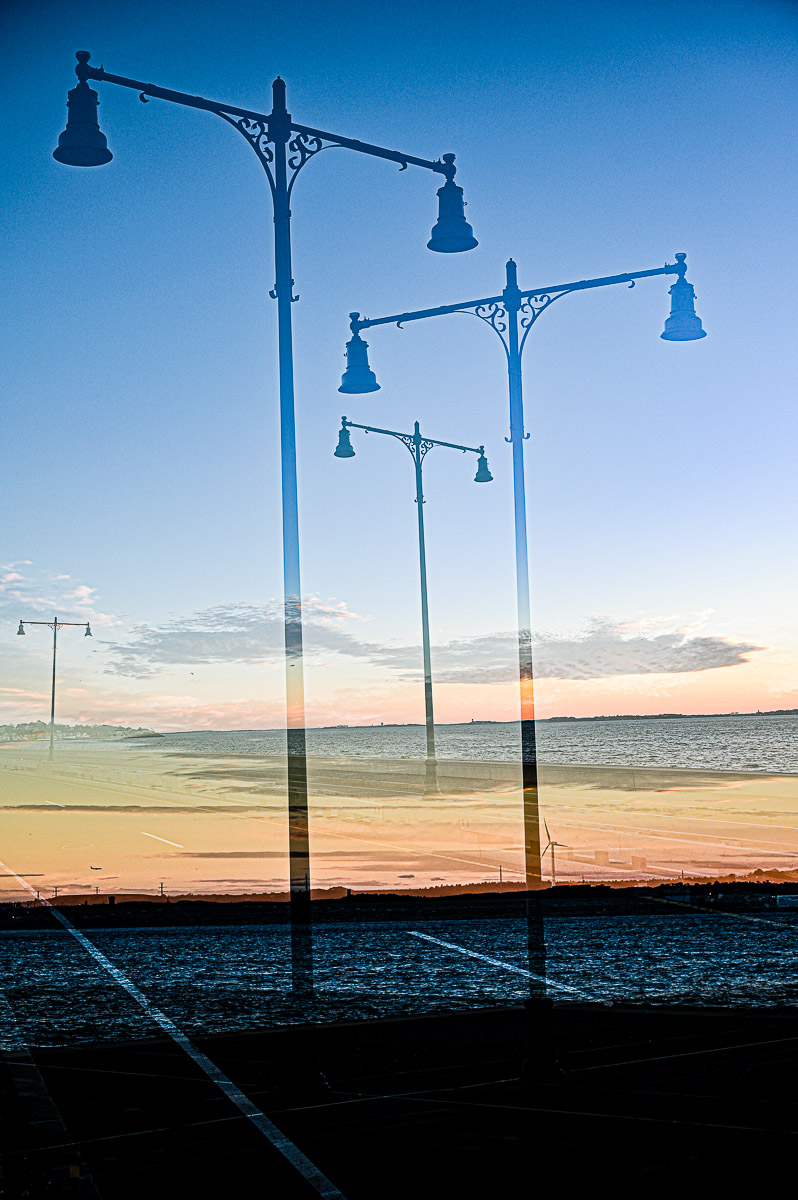
I think I might prefer the overall solidity of the colors and details in the version below.  And I love the precision the Z6's viewfinder screen preview afforded me while photographing as I nestled the lampposts into the composition. However, I resent spending time in Photoshop combining the images to make the resulting higher quality file.

Seasons of Life -  The Same 3 Images Combined in Photoshop

Old School Construction Finery
Back to light and George Eastman. The late afternoon sun raking across the buildings in Northampton, Mass. was riveting.  Capturing the scene, aligning four successive exposures using the screen in the Z6's viewfinder, brought me into the joyous present moment.

Into the Infinite

While assessing the results of versions combined in-camera versus those combined by hand, I zoomed way in to ascertain the qualities, blowing the images up to 200 percent.  Even then, discerning sharp differences sometimes proved difficult. Perhaps my research was skewed by wanting to only find evidence that backed up preconceived ideas. 

Do you think the above image Into the Infinite was combined in camera, or later by hand in Photoshop?

Professor John Nordell teaches courses in the Visual and Digital Arts Program that he created at American International College in Springfield, Mass. He blogs about the creative process at CreateLookEnjoy.com and teaches online Zentangle drawing workshops.