Some end-of-year need-to-spend-budget money landed us at American International College with a Nikon Mirrorless Z6 II and I finally had a little spare time to create in the midst of my midsemester crush. Grabbing the Z6, I had not even left my house when light forms on a window shade stopped me in my tracks.
 |
| “Light makes photography. Embrace light. Admire it. Love it. But above all, know light. Know it for all you are worth, and you will know the key to photography.” - George Eastman, Founder of Eastman Kodak Company |
George Eastman revolutionized photography several times over and made it available to the masses. His quote maintains its juice in our digital age.
In 2007, I acquired an early Nikon DSLR, a D200. This solid, trusty machine has served me well. I discovered that I could program the camera to purposely create in-camera multiple exposures. The process led to my
Reality-Based Abstraction series.
 |
| The Creation of Triangles - 3 Individual Images Automatically Combined Into a Single Jpeg File Inside the Camera |
Employing this multiple exposure technique I discovered with my D200, I used the mirrorless Z6 and shot three images of the light forms, angling my camera in different orientations.
When looking through the viewfinder of a mirrorless camera like the Z6, you view the scene you are photographing on a small digital screen. The scene comes through the lens and hits a sensor which sends information to the screen. With pre-mirrorless cameras, the scene travels through the lens, bounces off a mirror and up into a corrective prism housed in the viewfinder before reaching your retina.
When shooting multiple exposures, a digital screen embedded in the viewfinder like this allows to to see your prior shot images in the series and you can thus precisely align each successive image to complete your composition. Looking through the viewfinder, as I aligned the right hand triangle to just touch the edge of the top shape, I felt like Michelangelo precisely spacing the hands in
The Creation of Adam, one of his frescos gracing the Sistine Chapel's ceiling.
 |
| The Creation of Triangles - The Same Three Individual Images Combined by Hand After the Fact in Photoshop |
With the Z6, when set to create a multiple exposure, I discovered that the camera keeps each individual file and also combines the images into a single file. With the D200, you only ended up only with the single file of combined images. However, the combined file with the Z6 is the compressed, lower quality, Jpeg image file format, while with the D200, the combined file is a high quality, versatile, Raw format file.
I am baffled and disappointed that with this state-of-the-art camera the combined multiple exposure file is a lower quality Jpeg. On the plus side, I do end up with each of the individual files. I experimented with bringing the individual images into Photoshop and manually combining the files to end up with a higher quality multiple exposure (see above). I am vexed by this process, however, as I prefer spending my time creating images, rather than sitting in front of my computer.
Equally baffling with the Z6, is that the combined Jpeg is in the middle of the sequence of images, rather than at the end, making it difficult to determine which files to combine in Photoshop. (1/5/23 Update: I use Lightroom to view and edit images. If I sort the images by "File Name" rather than the default of "Capture Time," the combined Jpeg shows up at the end of the sequence of individual images.)
 |
| Michelangelo and Me - Simulation of Aligning the Individual Images for The Creation of Triangles |
 |
| Sketch for Seasons of Life - First of Three Images - Nahant, Mass. |
 |
| Seasons of Life - 3 Images Combined in the Camera - Jpeg |
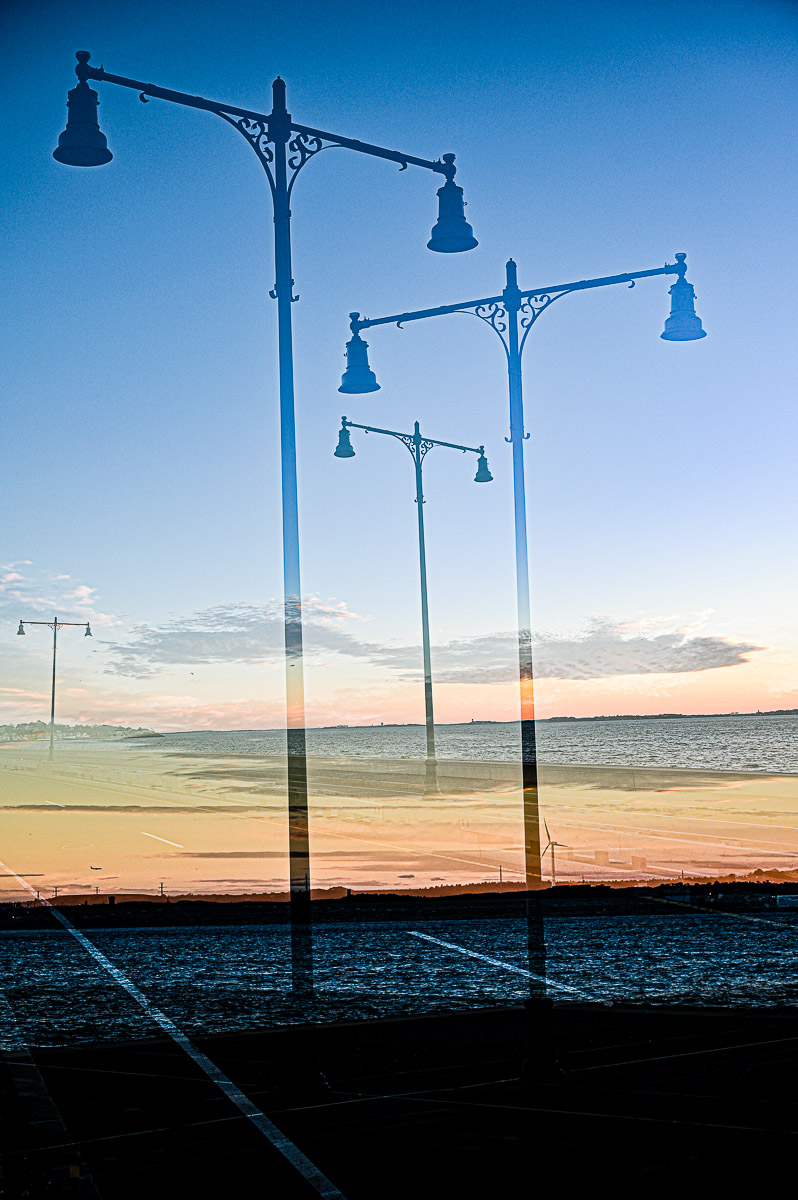
I think I might prefer the overall solidity of the colors and details in the version below. And I love the precision the Z6's viewfinder screen preview afforded me while photographing as I nestled the lampposts into the composition. However, I resent spending time in Photoshop combining the images to make the resulting higher quality file.
 |
| Seasons of Life - The Same 3 Images Combined in Photoshop |
 |
| Old School Construction Finery |
Back to light and George Eastman. The late afternoon sun raking across the buildings in Northampton, Mass. was riveting. Capturing the scene, aligning four successive exposures using the screen in the Z6's viewfinder, brought me into the joyous present moment.
 |
| Into the Infinite |
While assessing the results of versions combined in-camera versus those combined by hand, I zoomed way in to ascertain the qualities, blowing the images up to 200 percent. Even then, discerning sharp differences sometimes proved difficult. Perhaps my research was skewed by wanting to only find evidence that backed up preconceived ideas.
Do you think the above image Into the Infinite was combined in camera, or later by hand in Photoshop?
Professor John Nordell teaches courses in the Visual and Digital Arts Program that he created at American International College in Springfield, Mass. He blogs about the creative process at CreateLookEnjoy.com and teaches online Zentangle drawing workshops.