Showing posts with label Connection. Show all posts

November 9, 2024

A Day at the Beach

The heat of the semester often leaves scant time for my own artistic pursuits. However, this holiday weekend opened up a free day for me. I started off at The Coastal Center at Milford Point, a Connecticut Audubon Society bird sanctuary, and finished a few miles down the road at Silver Sands State Park. My students and the content I teach were with me, inspiring and pushing my explorations. Aside from the horseshoe crab shot, the other images were digital in-camera multiple exposures, as I overlaid 2, 4, 6, 8 or 9 exposures into a single file.

Sea and Sky - After Mondrian
Ocean Aperture
A digital evocation of the Kodak Projection Print Scale I used years ago in my darkroom.
Older Than Dinosaurs (Deceased Horseshoe Crab)
Ocean Cosmos
Boardwalk and Park Place!
Do you see rabbits or rocks?

Professor John Nordell teaches courses in the Arts, Media, and Design Program at American International College in Springfield, Mass. He blogs about the creative process at CreateLookEnjoy.com. Instagram: create.look.enjoy

April 9, 2024

My Experimental Film Image Chosen for F-Stop Magazine's Group Exhibition on Cities, Plus: "What is the purpose of photographs?"


Delighted that my image Steam and Birds, Manhattan was included in F-Stop Magazine's Cities issue. You can find my image if you scroll halfway down the group exhibit. Thrilled to have my work nestled amongst fascinating and varied views of metropolises.

Steam and Birds, Manhattan
This image is from a series shot using a 120mm lo-fi plastic toy camera called a Holga,  

However, I modified the Holga so I could shoot using 35mm transparency film. This is why the image bleeds into the areas around the sprocket holes. These are actual transparencies. No Photoshop. The scans of the transparencies were worked on in Lightroom.

One frame of 35mm film is 24mm tall and 36 mm wide.  One frame of 120mm film is a 56mm  square. I researched how to actually make the modification. I learned at Lisa Shea's HolgaPhotography.com how to make these physical modifications, using foam and rubber bands. Nicolai Morrisson on his site PhotonDetector.com presented a chart of how many clicks of the knob you need to advance the film between exposures. As the thickness of the film on take up spool thickens, you need fewer and fewer clicks per advance. You can see my check marks after I advanced the proper number of clicks. I loved the absence of a visual indicator as the technique relied solely on audio 


Life Will Not Be Denied, Brooklyn

(At the end of my day photographing in Brooklyn, I dictated this narrative into my phone.)

Arriving Brooklyn, driving under the railroad tracks with my daughter, the light was so beautiful, it was sunny, I saw pictures everywhere. After dropping her off, I set out in search of the rail line. Some areas around churches, the people seemed a little funky. But I’m looking down the street in the right direction, and there is the elevated rail line. I see where it goes underground, and I take a picture of the tracks through the fence, thinking of the picture that friend/photographer/collaborator Jaypix Belmer and I saw taken by the teens in Boston. I’m starting to do the 42 clicks or whatever, so I’m focused on that, and suddenly this guy in my face and says, “can you give me a buck for some fried chicken”? I said “no” and looking at my glasses he said “how about those Ray-Ban’s”? I almost started to say, “well they are prescription, and they won’t help you much", but he moved away. A little unnerving. And I lost track of how many knob clicks advancing film on the camera I had done. After this dollar fried chicken experience, I took a dollar out of my wallet and put it in my pocket so I could easily make a transaction without the vulnerability of opening my wallet.

Right On Time, Brooklyn
I kept looking for pictures, and there’s such a premium on the fact I have only 21 pictures on the roll of film. Kept having my friend/photographer/mentor Lou Jones’s voice in my head about needing access to people and their lives, or Jaypix talking about the importance of talking to strangers to get intimate photos. I went up on the Long Island Railroad platform, thinking of the Bernice Abbott photos taken from a train in Brooklyn that Jaypix and I recently saw at the Boston Atheneum.

I felt so much like I have to take a picture this way or I have to take a picture that way. It can’t just be a scene, there has to be action and people and shadows and complexity. I became angry and discouraged. And then I thought, “If it’s easy, everyone could do it”.

Stop, Look and Listen, Brooklyn
I took a picture of the back of a youth with cool hair and a shiny coat. But felt like a wimp. I came to the end of one street and there was a huge statue of General Grant on horseback, that added some liveliness. I was crouched down, waiting for six bicycles and 10 pedestrians with strollers to come by simultaneously. No such luck. People were scooting by on scooters and there were pretty good shadows. I needed to get to my next appointment, so I just decided, when this next scooter comes by, I’m going to get down low and snap a picture with the scooter in the shadow of the sculpture. So, I did that, but missed the scooter.

Ulysses S. Grant in Brooklyn
It was great then visiting friend/artist/photographer Keris Salmon and meeting her daughter and talking about our both having been stuck in a creative rut and the struggle of getting out of a rut. Seeing all of her art and all her books on art and hearing about the new project she doing, I left inspired and the light was getting even more gorgeous. I saw a tall thin building that was amazing, so I kept walking towards it. Tried to get a fire escape and a tree with the building, but again the very frugal with film, I didn’t take it. But then, looking up at the tree with a sliver of building, I think I burned the frame. 

Light So Thick You Can Touch It, Brooklyn
Got closer to the tall building and it was kind of interesting, but there was a huge crane and the light on it was just fabulous. So, I think I took a picture of the tall building with the crane. I also remembered at one point, that I could do multiple exposures, so I think I did one at this point. Then I did a double exposure of the incredible crane overlapped wigs for sale. 

Heavy Lifting, Brooklyn
I loosened up, had more fun. This was good because I realized I was so wrapped in what I should be shooting and how I should be shooting. It’s great to have a mentor and friends who are photographers, but I gotta be me.

Walk This Way, Brooklyn
That evening, during a massage I imagined building little boxes and having the film transparencies with images with the sprockets showing mounted in the boxes and there would be lights in the boxes making them glow. I first thought that it would be a standalone image, but then I thought of a larger piece of driftwood with maybe six panoramas in it.

Just before the massage I had gone into a branch of the New York Public library. There was an Aperture Magazine with an essay titled, “What is the purpose of photographs?” Any photograph is simply a record, it postulated, but are they art, as well? After my exciting day taking pictures in Brooklyn, I realize that the purpose of photographs is for the photographer to derive enjoyment from the act. Also, on the massage table I had affirmed to myself: I am a photographer. I am an artist. I can do whatever the f*ck I want.

Oh my God, the voices in my head.

Professor John Nordell teaches courses in the Arts, Media, and Design Program at American International College in Springfield, Mass. He blogs about the creative process at CreateLookEnjoy.com. Instagram: create.look.enjoy

April 4, 2024

"The Surveillance Camera at Plymouth Rock" featured in the 2024 MAEA Art Educators Exhibit


Delighted that my image makes its public debut at the Massachusetts Art Education Association Art Educators Exhibit that runs March 14 - April 16, 2024 at The Gallery at Villageworks, 525 Massachusetts Ave, West Acton, MA 01720

A couple of weeks ago I helped hang the show and my colleagues' artworks are seriously inspiring! 

Opening reception 7-8 pm on April 11th.  

The Surveillance Camera at Plymouth Rock, 2023

I have been making a series of digital in-camera multiple exposures called Reality-Based Abstractions since 2008. This image was made technically possible by using a Nikon Mirrorless Z6 II DSLR camera. I had programmed the camera to layer three consecutive shots into a single image file (see below). However, unlike earlier digital Nikons I have used, the Z6, along with combining the three images, also keeps each individual image file. Thus, instead of the flag image used above being solely embedded in an unalterable layered file, it was available to combine in Photoshop with a close-up shot of the surveillance camera.

Mayflower, Columns and Flag

Rock and Camera
The monument in Plymouth, Mass., which purportedly marks the spot where the Pilgrims arrived, was vandalized twice in 2020, 400 years after the landing.

Hence, the surveillance camera.

Legendary History

An in-camera multiple exposure of the edifice:

Time's Grid

So many legends and falsehoods swirl around the Pilgrims arrival. Perhaps abstraction constitutes a more accurate portrayal.

Landing of the Pilgrims, 1825, by Samuel Bartoli

I recently came across this powerful juxtaposition of paintings at the Peabody Essex Museum in Salem, Mass.  The label clarifies some of the myths.

History Through Art
Pilgrim Point, 1947, by Karl Knaths

Near Plymouth Rock, a replica of the Mayflower, one of crafts that conveyed the Pilgrims, bobs in the harbor waters.

The multiple exposure below might look like reality unless you understand how the ship's rigging for the sails actually works.

Life Lines

I layered three views of a raptor that soared above The Mayflower into a single image. 

Soaring Towards Clarity

Accurate history is elusive.  I am intrigued by the power of belief; that you can believe in an idea that my not be true, yet it can give you purpose, direction and meaning.

What's your Plymouth Rock?

Professor John Nordell teaches courses in the Arts, Media, and Design Program at American International College in Springfield, Mass. He blogs about the creative process at CreateLookEnjoy.com. Instagram: create.look.enjoy

March 2, 2024

Chasing Berenice Abbott's Light in Boston's South End


Planting inspirational seeds in advance of my students taking images on the topic of “Cities”, l showed them photographs of New York City, including “New York Stock Exchange, New York”, 1933, by Berenice Abbott.

Stepping Out - Or Was It In?
Today, l chased her light, taking pictures in Boston’s South End. These images are interspersed with photographs l shot in 1977, at age 18, living in the same South End, studying the city and its people.

Alley Tree
Back then I shot with a Nikomat, developed and printed the work myself, and then glued the images into a photo journal.

Contrails Can Suppress Daylight
Today, I used an iPhone from my pocket and posted here and on Instagram.

Shadowy Alley
It is so fun to still be exploring the world, chasing light and shadow, regardless of the capture device and method of presentation.

Echoes of Japan
They say the best way to learn is to teach.

Sunny Day
So glad that planting city seed images for my students reawakened an exploratory mindset for me.

Professor John Nordell teaches courses in the Arts, Media, and Design Program at American International College in Springfield, Mass. He blogs about the creative process at CreateLookEnjoy.com. Instagram: create.look.enjoy

February 3, 2024

"Dynamic Legacy Ladder" Chosen for F-Stop Magazine's Group Exhibition on Color


So excited to be rubbing virtual shoulders with photographers from 33 countries as my image Dynamic Legacy Ladder was included in F-Stop Magazine's Color themed issue.

F-Stop Editor Christy Karpinski told me that there were probably 2500 images submitted from around 330 different photographers.

Dynamic Legacy Ladder

I strongly urge you to visit the exhibit and engage with the diverse approaches that employ a single medium to interpret the theme of color.  It is a honor to join this legion of creatives.

You can find my image if you scroll halfway down the exhibit.

View the Exhibit

I have been working on a series of digital in-camera multiple exposures since 2007.  See these Reality-Based Abstractions.

I broke new ground with Dynamic Legacy Ladder by choosing to make one exposure in color and the other in black and white.  This new direction can be traced directly to my recent collaborations with photographer Jaypix Belmer.  Big thanks to Jaypix for the inspiration!

Dynamic Legacy Ladder in F-Stop Magazine
Big thanks as well to F-Stop Magazine's Editor Christy Karpinski for providing a showcase that unifies humanity through art.

Professor John Nordell teaches courses in the Arts, Media, and Design Program at American International College in Springfield, Mass. He blogs about the creative process at CreateLookEnjoy.com. Instagram: create.look.enjoy

November 11, 2023

Moment of Focus Exhibit Curated by Jaypix Belmer - Celebrating the Past, Present and Future of Boston Hip-Hop

Pacey Foster from the Massachusetts Hip-Hop Archive at UMass Boston connected me with Jaypix Belmer, as Belmer was curating an exhibit on Boston Hip-Hop at Black Market Nubian in Roxbury, MA.

During our initial phone conversation, Belmer and I hit it off.  We discovered a mutual love of creating multiple exposure photographs.  We also both find inspiration in the work of photographer Eugene Richards.

I was honored to have my 1980s images of the Boston Hip-Hop scene on view along with Belmer's contemporary images.  The exhibit coincided with Hip-Hop's 50th anniversary.

Photo by Jaypix Belmer

The Boston Globe's James Sullivan attended Moment of Focus and wove vignettes from the event into his article:  In the early days of hip-hop, Boston made its own history.

He made mention of me and my work:

"His photos from various venues around the city were a prominent feature of the recent “Moment of Focus” exhibit, and they made up the bulk of “Hip-Hop: Seen/Unseen,” an exhibit that ran from August until mid-November in Dewey Square on the Rose Kennedy Greenway.

“When I see my photos, it’s about the youth,” said Nordell, now a professor at American International College in Springfield. He recently donated his negatives to the Hip-Hop Archive."

My images were used to illustrate the article.

A history of Hip-Hop in Boston without acknowledging Rusti Pendleton, shown above scratching with his toes, would be woefully incomplete.

Photo by James Bynum

A scant few of my Boston Hip-Hop images were published in the 80s. The rest would still be unseen if record store owner and historian Brian Coleman had not tracked me down to find out if I had more.  Thanks again Brian!

A big thank you as well to Jaypix Belmer for including my work in the Moment of Focus Hip-Hop Exhibit.

Professor John Nordell teaches courses in the Arts, Media, and Design Program at American International College in Springfield, Mass. He blogs about the creative process at CreateLookEnjoy.com and teaches online Zentangle drawing workshops.  

February 11, 2023

On Mentors and Black & White Images Published in F-Stop Magazine


Two images I submitted for the F-Stop Magazine 2023 Black & White Group Exhibition were selected for the February-March publication.  Magazine Founder and Editor Christy Karpinski said that 530 people submitted a total of 3800 images.  She chose to exhibit 250.  I am thrilled and honored to be included in this stunning exhibition.  I highly recommend that you view the entire show.

Both images are from my Reality-Based Abstraction series, which are digital in-camera multiple exposures.

Bridge to Somewhere, 2022

I photographed Bridge to Somewhere on a frigid January morning in Boston.  View more images from this shoot.  

Bridge to Somewhere, published in F-Stop Magazine 

Black Sheep (Snow, Sun, Trees), 2021

You can learn more about the context of creating Black Sheep(Snow, Sun, Trees) in my blog post "The Glory of Mistakes". 

Black Sheep (Snow, Sun, Trees), published in F-Stop Magazine

Along with the above selected digital offerings, I submitted other black and white images, including some shot on 120 film using a cheap plastic toy camera called a Holga.  More on this camera and my explorations with shooting film.

Neither of these images were selected for publication.  I still love them.  And I am fond of the way the rough, soulful, earthy feel of film contrasts with controlled digital sharpness and precision.

Connecting to Spirit, 2022

Speaking of soulful, one of my early mentors, Jerry Berndt, encouraged me to use different kinds of cameras to struggle with adjusting back and forth between different gear with different controls to combat complacency and routine ways of capturing images.

Myles Standish Above the Sea, 2022

I miss you Jerry.

Professor John Nordell teaches courses in the Visual and Digital Arts Program that he created at American International College in Springfield, Mass. He blogs about the creative process at CreateLookEnjoy.com and teaches online Zentangle drawing workshops.  

September 21, 2022

Stepping Out of the Comfort Zone Part 327


I contacted Anna Hepler about doing a collaborative project involving her creating art and me playing drums. Anna is a friend, mentor, brilliant artist and collaborator on previous projects.

My father played jazz drums, leading a combo.  I inherited his bare-bones drum set.

At a minimum he wore a coat and tie for gigs; for fancy events, he and his band wore tuxedoes.

Following my father’s lead, I suggested to Anna that we dress up for our art and music experience.

We had a brief planning phone call before getting together.

When I arrived at the former industrial building that houses her studio, Anna emerged on the loading dock and upon seeing each other we just burst into laughter.

I said, “If I ask my students to step out of their comfort zone, I have to do it myself!”

She replied, “Yes… but for some people stepping out of their comfort zone means using more yellow paint, not getting dressed up and doing this (entering unexplored territory).”

We decided to do one take with me as leader.  Then another take with her as leader. And then one with both of us leading.

We changed outfits for each experimentation.  I somehow thought the video camera angle of view would only capture my waist up coat and tie formality.

The first take was slightly stilted as we were like two individuals operating mostly independently.  By the second take, a synergistic, natural call and response type of thing emerged.

We hoped ultimately for cohesive improvisation. And found it.

It was a joyous experience.  We each brought our own strengths to table.

Reflecting on the collaboration, we at first discussed possible meanings and interpretations.   In the end, we wanted the performance to speak for itself.

As Anna concluded, “I want to treasure the experience as an experience.”


My dad performs at a gig:

Rod Nordell


August 4, 2022

What do photography and fishing have in common? Tales from a mill pond.

With time to spare before collaborating with photography teacher Jess Lazarus at Pembroke (Mass.) High School, I discovered a herring fish ladder at nearby Glover Mill Pond.  I packed a plastic Holga camera loaded with a fresh 12 exposure roll of film. (Click to learn about this camera.)  

I set out to tell the story of the fish ladder with the enabling constraint of only 12 shots.  Like a baseball pitcher waving off a proposed pitch from their catcher with a slight head shake, I moved on without pressing the shutter button when what I saw through my viewfinder did not measure up.
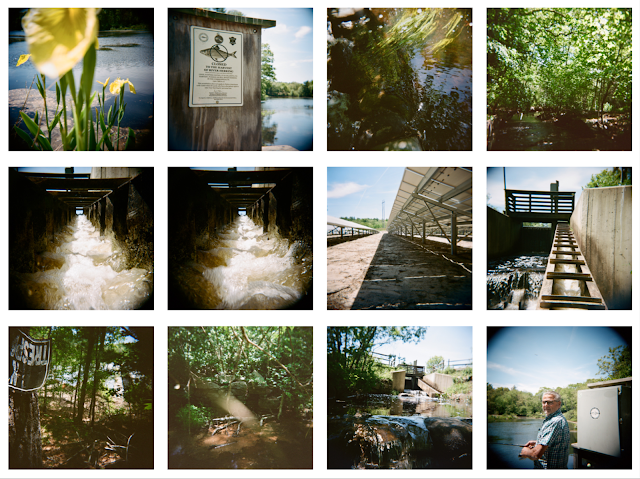
12 Images - The One Repeated View Was to Refine the Plane of Focus

Knowing I would soon be in a classroom of eager students prompted me to be mindful of my creative process and decision making.  What wisdom could I distill from this documentary experience to effectively teach about storytelling, framing, lighting and exposure choices?
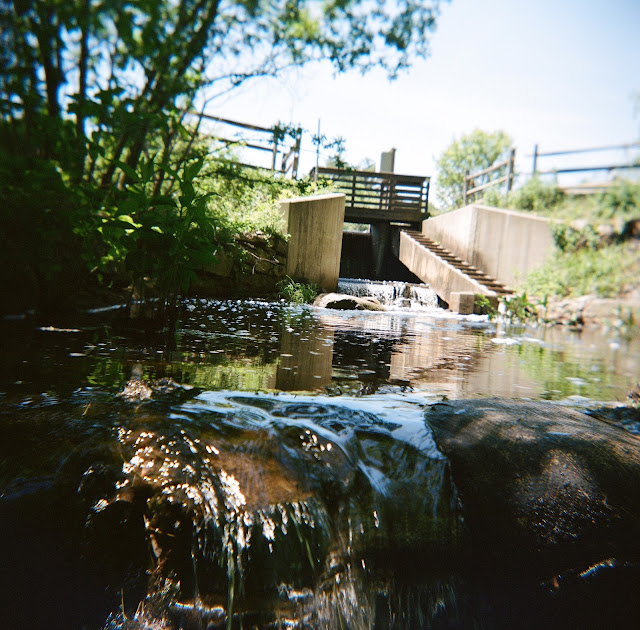
Fish Ladder is at the Upper Right Rule of Thirds Crash Point

Herring are born in rivers, travel downstream, and then live in the ocean before returning to their birthplaces to spawn.  River dams built for industrial purposes, such as creating water power for 19th century mills, obstruct the upstream progress of the fish.  Fish ladders are thus built to facilitate the passage of herring up and over the dams.  
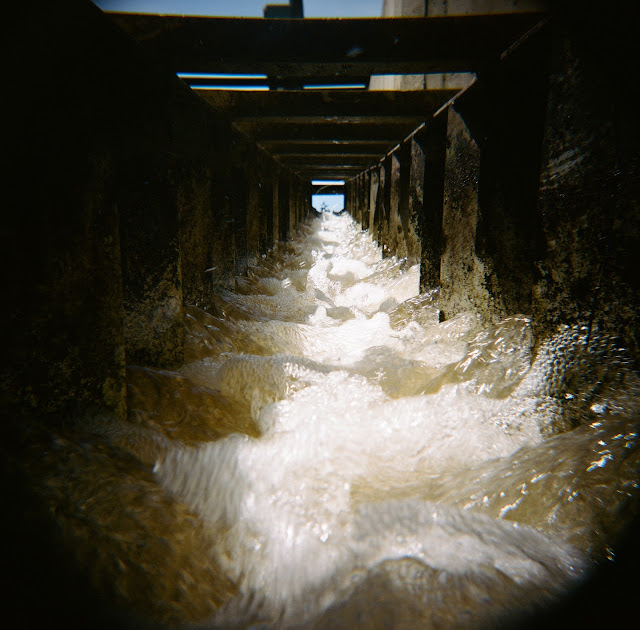
Imagine Swimming Up this Fish Ladder 

The day before this exploration I met with legendary photographer Lou Jones.  I knew him from the 1990's Boston commercial photo scene.  We reconnected a few years ago as he mentored a few of my students.  Subsequently, from my viewpoint, he has slid into the mentor seat for me.

"I feel like I keep taking the same picture over and over," I said to Lou, describing a creative photographic rut.
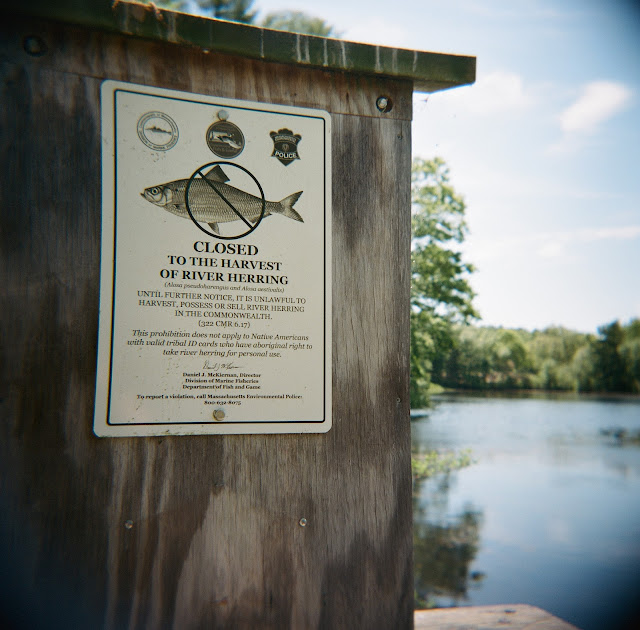
Protecting the Herring

Lou replied that while when you look through the viewfinder there are thousands of considerations in terms of camera settings, exposure, light, etc., and over time you can refine the speed with which you make these split second decisions.  However, none of that matters unless you have access to interesting subject matter.  (Lately Lou has been photographing in Kenya for his panAfricanproject: Redefining the Modern Image of Africa, and capturing IronWorkers walking across girders 53 stories above Boston.)
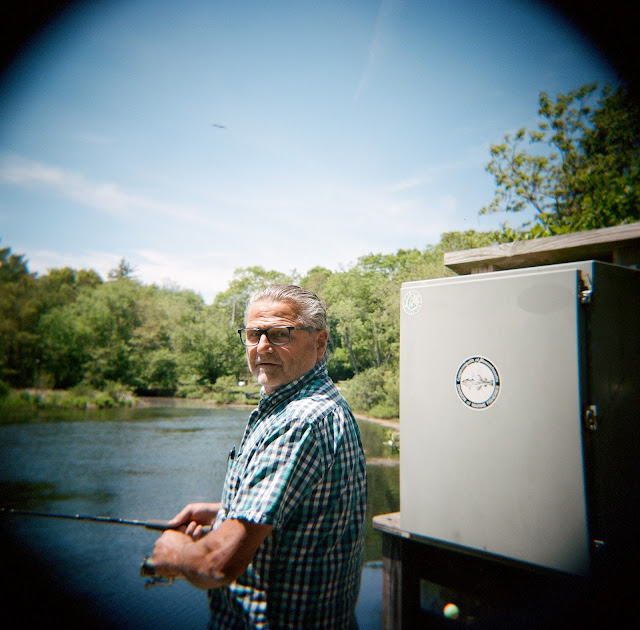
A Great Blue Heron Flew Across the Sky as I Photographed Gino Fellini

Fueled by Lou's urgings, when I saw this fisherman, I summoned the courage to ask if I could take his picture, thereby gaining access. In my photojournalist days, I went to the Soviet Union on a tourist visa, climbed over fences to photograph Super Fund sites and disobeyed Secret Service agents.  Lately, however, ensconced in the Ivory Tower, I have been timid with approaching strangers, let alone trespassing!
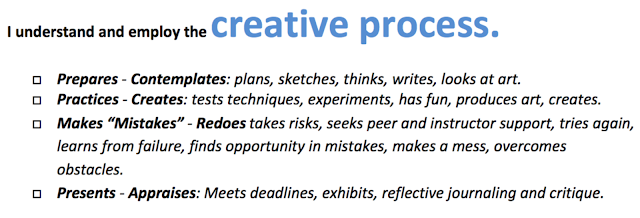
For My Students, Found in Their Syllabi

Gino Fellini, who has been Pembroke's Conservation Chair, explained the ins and outs of the herring restoration program.  Also, as he described his process of recreational fishing, I found parallels to the creative process that I strive to imbue into each cell of each student.

Seeking to deepen the connection, I asked Gino to write an explanation of his fishing process.  He graciously complied via email:

Hi John,


It was a pleasure meeting you. As far as fishing being a “process” I refer to the actions associated with the routine of rigging, tying knots, selecting a rod and reel, a variety of lures to experiment with, artificial or live bait, hook size and style, etc.. The process also includes location, time of day and season, weather and wind conditions, water temperature, water clarity and depth, hook set, retrieval speeds... Every day is different. I’ve had a variety of successes and failures. 


My happiness is not predicated by how many or how large a fish I catch. For example, at the pond where we met, Ive gone weeks without a substantial catch and then boom 10 large mouth bass of average size in an hour! The next day only 2 bass, but the first was over 4.5 lbs, number two was 3.5 lbs. then nothing again for a while. The process is not all about the fish. While fishing I am observing and contemplating the sights and sounds of nature that surrounds me. It has afforded me a myriad of experiences that can be as rewarding as outsmarting and landing a whopper! 


So that’s it. The process in a nutshell. 😎


Thanks,

Gino
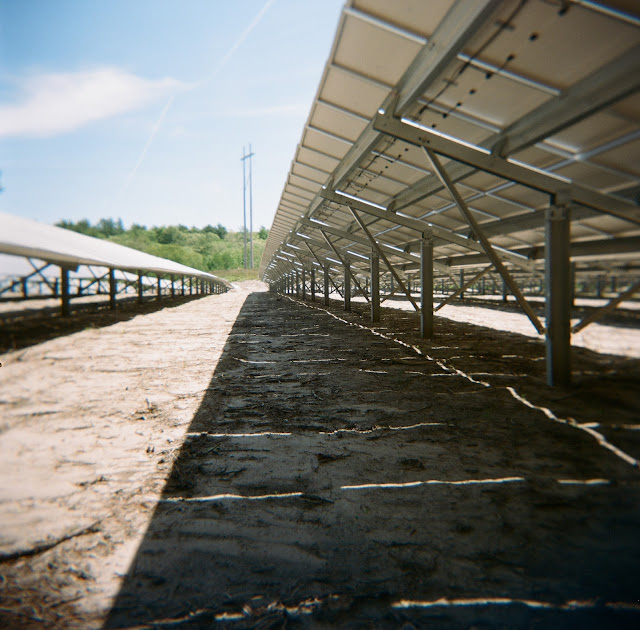
From Water Power to Solar Power: This "Farm" is About 100 Yards from the Dam
"The process is not all about the fish." Amen, Gino!  Yes, I had a camera and took these images. However, I also connected with another human, enjoyed a brilliant summer's day, learned, reflected, had fun, experimented, took risks, made psychic connections to students and mentors, and delighted in the wonders of nature.

Like fisherman, we photographers also love to tell stories about "the one that got away."

John Nordell teaches courses in the Visual and Digital Arts Program that he created at American International College in Springfield, Mass. He blogs about the creative process at CreateLookEnjoy.com   Instagram: @john.nordell