So excited to be rubbing virtual shoulders with photographers from 33 countries as my image Dynamic Legacy Ladder was included in F-Stop Magazine's Color themed issue.
F-Stop Editor Christy Karpinski told me that there were probably 2500 images submitted from around 330 different photographers.
Dynamic Legacy Ladder
I strongly urge you to visit the exhibit and engage with the diverse approaches that employ a single medium to interpret the theme of color. It is a honor to join this legion of creatives.
You can find my image if you scroll halfway down the exhibit.
I have been working on a series of digital in-camera multiple exposures since 2007. See these Reality-Based Abstractions.
I broke new ground with Dynamic Legacy Ladder by choosing to make one exposure in color and the other in black and white. This new direction can be traced directly to my recent collaborations with photographer Jaypix Belmer. Big thanks to Jaypix for the inspiration!
Dynamic Legacy Ladder in F-Stop Magazine
Big thanks as well to F-Stop Magazine's Editor Christy Karpinski for providing a showcase that unifies humanity through art.
I acknowledge my limitations as a draughtsman. However, I am a firm believer that the act of creating, at whatever level, whether drawing, making, repairing, baking or fabricating, leads to enhanced creativity and enjoyment of life.
How did I get here?
Engaging in the creative process of refining lesson plans for teaching Zentangle workshops, I have been drawing combinations of abstract Zentangle patterns. With my sketchbook open and pen working away, I also began a series of character drawings.
Not sure why, but I think I'm going to cry.
The pen in my hand brought me into the moment. Suddenly, out of nowhere, my characters had sentient thoughts.
I'm waiting for Pablo Picasso to paint me.
So, back to my original premise: the act of creating fosters creativity.
Something feels wrong with one of my eyes.
I might be the only person enjoying these visual musings... but my new friends crack me up with their insights.
Bet you wish you had hair like mine.
I impress upon my students the necessity of taking risks to jump start artistic growth. Well, I sure feel exposed and vulnerable publishing these drawings. And, when I spend time drawing, my skills increase.
Flash light person.
I hope you will join me in risk-taking and creating.
Without looking, write a list of all the details you can think of that describe your front door, or the entryway to your abode. Here's mine:
1. Light on left.
2. Gold handle - outer door.
3. Metal railing.
4. Three concrete steps.
5. Wood sticks out.
6. Front door color is bluish grey.
Then go and take pictures of items on your list.
3. Metal railing. 4. Three concrete steps. 5. Wood sticks out.
My imagined list was spot on, except for the color. Bluish grey was the door color of a house I moved out of 14 years ago!
1. Light on left.
In my defense, I always use the side door.
2. Gold handle - outer door.
Taking pictures for me is a form of mindfulness. I try to use all my senses to become attuned the present moment conditions. This approach helps me see clearly and creatively.
The initial concept of this exercise was to test my recall of everyday encounters. However, photographing details of a common sight led me to see it in an uncommon way:
At the start of the semester in my Cultivating Creativity class, I ask students to note three of their top character strengths from the VIA Institute on Character's listing of strengths. The idea is to start the semester with confidence in one's abilities. I invite you identify some of your key strengths. Click here for the list.
I kept walking past my camera bag thinking, "I really should take some pictures." Distracted by the impact of Covid-19 on my life, and learning how to shift my face-to-face courses to online delivery, my camera remained untouched.
This Sketch Became...
Finally, I grabbed it and started shooting.
X-Ray Vision
It felt so good to take pictures. This process has been a love of mine for nearly 5 decades.
This Sketch Became...
Preparing to take a multiple exposure, I take a single frame to test for exposure, like an artist's sketch.
Raw File
The layered images that emerge from my digital camera are flat looking, so I treat the files to pull out vibrancy and details. In the case below, I reversed the above image to look like it was a color negative.
Home
A mere ten minutes of shooting opened my heart and mind to a present moment of peace. I printed the images out and put them in my kitchen. Each time I walk by and see them, I smile. In the face of current uncertainty, feeling competent and creative helps me feel a sense of needed normality.
Look at the effect of 8 minutes of taking pictures followed by a couple of minutes collecting shell fragments at the beach on blustery December morning in Lynn, MA
The Joy of Creating
Blank Canvas
Shakti - Multiple Exposure
Gulls drop clams from the sky to break the shells on the sand and then eat the contents. Thinking of my Visual and Digital Arts students, I collected shell fragments to be used in class for creating cultural jewelry.
Cycles of Life
Later, I photographed an in-camera multiple under the tracks in downtown Lynn.
Opening reception: In conjunction with Arts Night Out, Friday, October 11th, 5:00 - 8:00PM, at Forbes Library’s Hosmer Gallery, 20 West St., Northampton MA
Exhibition jurors: Donna Gates, Gallery Director and Curator, Salmon Falls Gallery; Jameson Johnson, Founder and Editor in chief, The Boston Art Review; Robert Wiesenburger, the Associate Curator of Contemporary Projects for The Clark Art Institute.
Friend and artist Keris Salmon recently introduced me via email to an artist friend of hers, Anna Hepler. When Hepler and I met (we both live in Greenfield), I learned that she often originates a certain idea/form and then manifests the same idea/form in a variety of media, such as clay, wood and block printing. Her multiple renderings of a single idea in a various ways planted a seed in my creative vision.
Drawing with Dew
I sometimes do Zentangle drawing, an art form that blends drawing and meditation. By drawing repeated, structured patterns, abstract beauty emerges. Normally, with Zentangle, I use a pen and pencil, drawing on 3.5 inch squares of paper. Inspired by Hepler’s multifaceted approach, I wondered what it would be like to make a computer generated 3D print of a Zentangle pattern and then block print it, or draw on a scale so large that the image would only be fully visible from the sky.
Rick's Paradox - Straight Lines Create Curves - Zentangle Drawing (Not in the exhibition)
My personal artistic vision is one of open-minded exploration. While I love to go back in time, such as drawing with ink made from crushed berries, I also warmly embrace the use of contemporary digital tools. The fruition of my project combined elemental mark making using my feet with using a drone for aerial imaging of the large-scale artworks.
Drawing with Sand
One time I drew by shuffling my feet through dewy grass on the field behind Four Corners School in Greenfield, Mass. Another time, at the Green River Swimming and Recreation Area, I made lines in the sand with a single foot. At Walden Pond in Concord Mass., my drawing straddled the shoreline, with some lines continuing from the sandy beach under the pond’s surface. In each location, upon completing the drawing, I sent my drone aloft to photograph the work from on high.
Drawing with Sand and Water (Not in the exhibition)
My project bore so many fruits: ephemeral artwork that lasted mere hours before evaporating or being walked on; cardiovascular benefits as I worked up a sweat by walking/drawing; a mindfulness practice of literally taking it one step at a time, and a necessity to focus on the process, as I could not even see the product without flying a drone into the sky!
Thank you Anna Hepler for planting the seed.
It takes a village... Big thanks also to former students Jason Kan and Zach Bednarczyk who have taught me everything I know about piloting drones for aerial imaging. Thanks also to Jason for emboldening me to push the limits when editing images in Lightroom. I would be remiss to not mention Cheryl Cianci, who I met at a gallery in Hartford. Her enthusiasm about the Zentangle drawing method led me to become a Certified Zentangle Teacher.
"Gallery A3 is excited to announce its 6th Annual Juried Show, to be held August 1-31, 2019, with an opening reception on Thursday, August 1, from 5-8 pm."
I am excited that my image Manifold Histories was selected for the exhibition. Hope to see you at the opening reception! 28 Amity Street, Amherst, MA.
Manifold Histories
The digital image, an in-camera multiple exposure from my Reality-Based Abstraction series, melds multiple viewpoints simultaneously of the Summit House porches:
Porches and Pathways
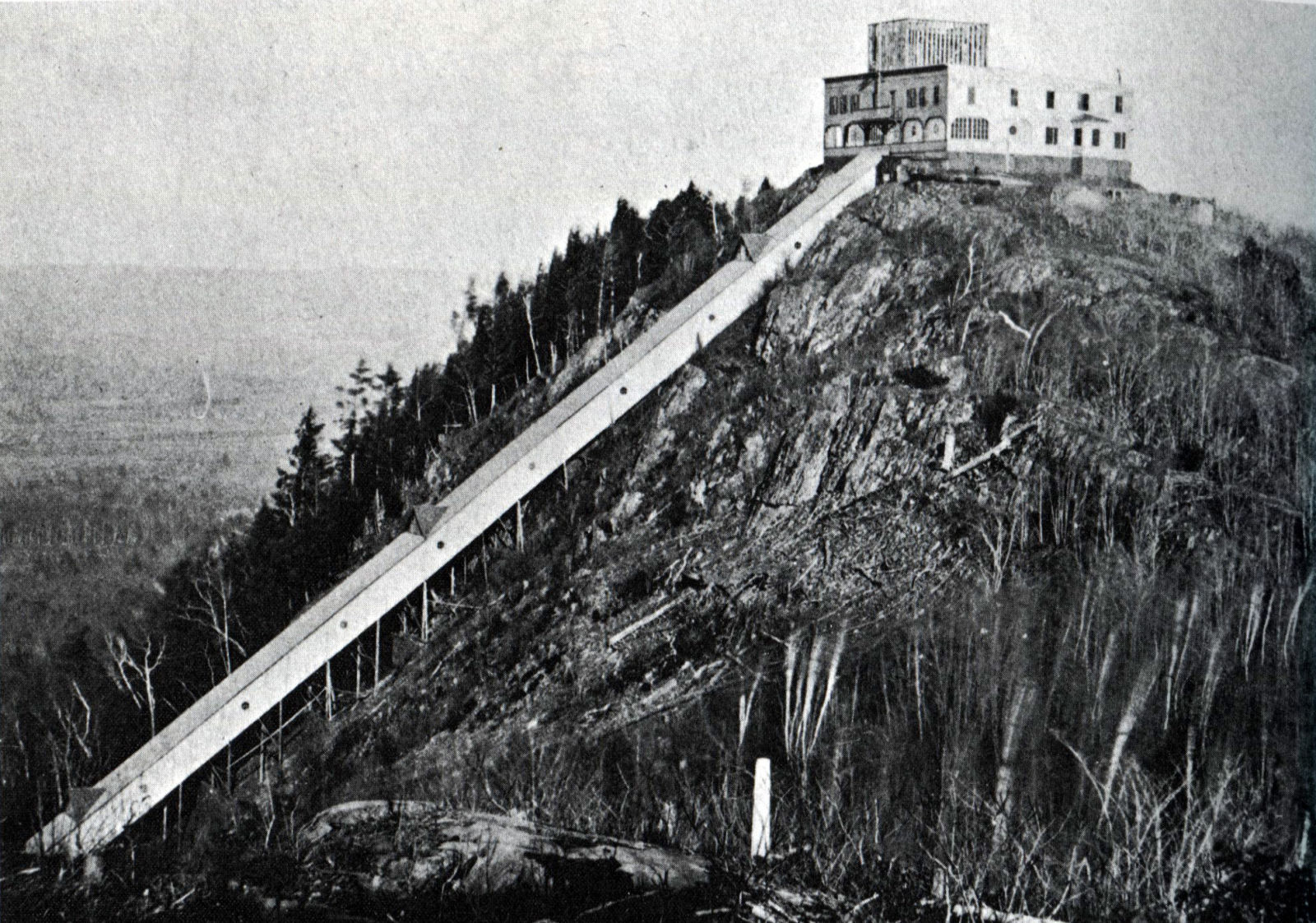
This view from Mt. Holyoke has seen many changes, from industrial ascent and decline to the digital revolution. According to MassMoments, "With the closest source of water halfway down the mountain, John French built a wooden railway to haul barrels of water up the track. Power was provided by a horse hitched to a circling crank at the top. French soon realized that, properly equipped, the tram could also transport people. He installed the body of a sleigh, and passengers were soon being carried over 600 feet up the mountain. Moving at a 38-degree angle, riders had the sensation of being pulled almost straight up."
The Covered Tramway, circa 1860. Photo courtesy of MassMoments
In 2017, a Mt. Holyoke College graduate looked to creating her history:
Bring it On!
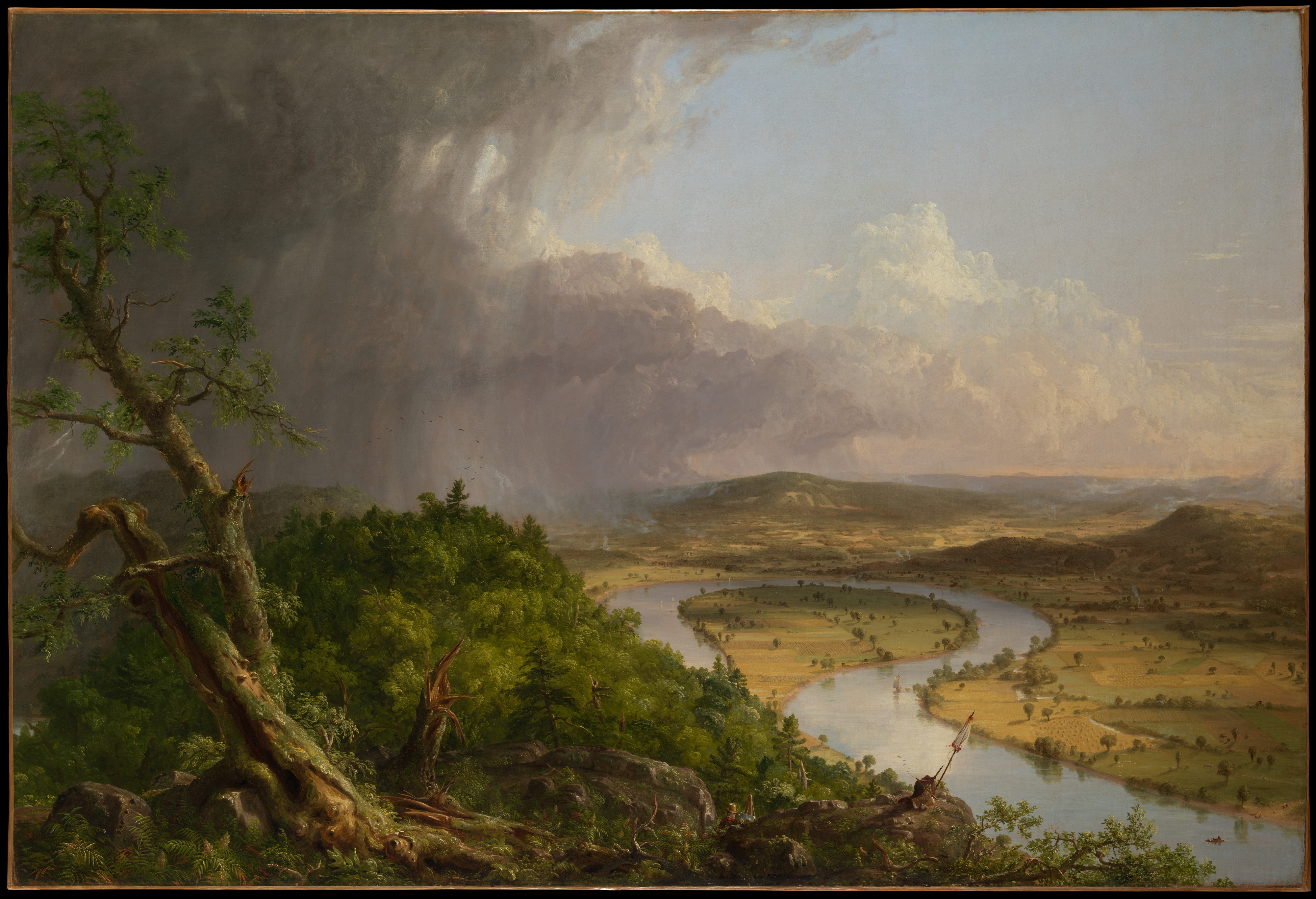
In the far distance, beyond the Connecticut River, is the Oxbow, a shape evocative of the apparatus placed over an ox's neck that connects the animal to a wagon. You can see the Oxbow clearly in Thomas Cole's painting:
View From Mount Holyoke, Northampton, Massachusetts, After a Thunderstorm - The Oxbow, by Thomas Cole, 1836, The Met
In the same way Cole (bottom center of the painting) looks at the viewer, perhaps asking, "What do you think?", I encourage my students to look closely at this painting. They pick out the trees cut down for farming, the storm clouds, the broken tree. "Might the cut trees and storm foretell the industrial revolution that severely polluted these waterways?" I ask.
One day riding my bike I happened upon the Oxbow Water Ski Show Team demonstrating their athletic waterborne artistry on the Oxbow. My water ski lesson starts at the 56 second mark in the video.
I wonder what Thomas Cole would make of this activity. You would need hundreds of horses attached to a circling crank to power one of the boats.
The Many Forms of Water
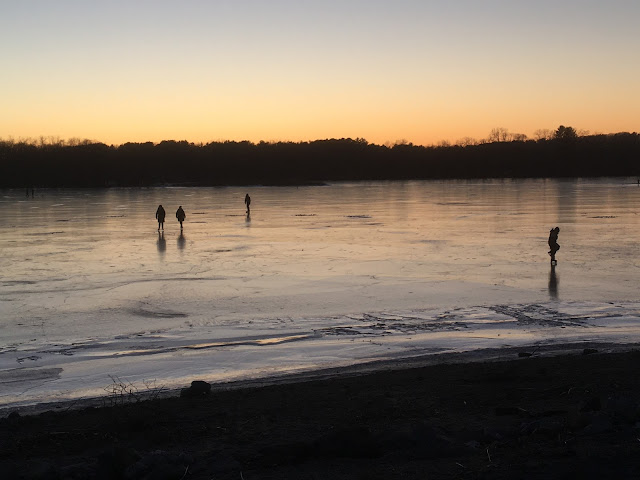
Image added January 2022. In the exact areas where I water skied, people ice-fished and skated. After overcoming my fear if the ice was solid, I sort of slid-skated along the ice in my winter boots.
It was a great experiment in summer 2018, shooting film as a way to limit living a digital life and to get back to my photographic roots. Starting as a boy, and then later at a professional, I developed and printed hundreds of rolls film by hand.
I used these three cameras. On top, my first Nikon, from the 1970s, a Nikomat (aka Nikkormat), purchased for me by my uncle in Hong Kong. It had a roll of film in it that I started shooting in 2011. I obtained a new battery for the light meter, but did not know if it would work.
In the middle is a medium format Holga. I bought it used for $10 at the In-Sight Photography project in Brattleboro, VT. I had no idea if it was functional.
At the bottom is a Diana Mini. The complex and creative film photographer Beth Maciorowski spoke to my photography students and suggested they use this camera for their nascent film explorations.
Beth also explained how to create multiple exposures and incremental, overlapping panoramic images. Thank you Beth for the inspiration.
I shot six rolls of film before sending them off for processing. Bye-bye instant digital gratification. The anticipation built as I waited to see the scanned film.
I cannot fully describe the thrill of seeing the scans of my film images. On one hand, I see them as rough, imperfect and bursting with soul. They disrupt clinical digital perfection.
I vacillate though, wondering if I am making romantic excuses for sometimes messy, unsharp and grainy images.